Las bicicletas indoor siguen siendo una de las máquinas más populares y asequibles para hacer cardio. Por ello también son las más utilizadas en las clases dirigidas de los gimnasios. Su uso es muy sencillo. En GymCompany ofrecemos un amplio y diverso catálogo para que puedas elegir la mejor bicicleta indoor para ti, con más de 150 modelos de uso doméstico y/o semi-comerciales, y disponemos de las más importantes marcas internacionales: Sole Fitness, Life Fitness, BH y muchas otras. Antes de comprar una bicicleta de spinning, te invitamos a repasar nuestra guía para luego recorrer nuestro catálogo y elegir, sin ninguna duda, entre estas mejores marcas y modelos de bicicletas de ciclo indoor del mercado español y mundial.
Además, si vives en Barcelona o cercanías y deseas ver o probar un modelo de bicicleta de spinning o cualquier otra máquina en particular, puedes visitarnos en nuestro showroom de Sant Cugat y probar todos los modelos que tenemos en exposición.
Sencillo: para construir un modelo de calidad, la ingeniería necesaria es mucho más modesta que para otras máquinas de gimnasio, como las cintas de correr. Dicho de otra manera, la relación calidad precio de las bicicletas de spinning es una de las mejores del mercado y sin renunciar a las mejores prestaciones. En definitiva, el ciclismo indoor es un ejercicio físico apto para casi todos los públicos y con unos beneficios para el organismo altamente demostrables tanto para adelgazar como para tonificar piernas y glúteos.
Ahora bien, adentrémonos en la historia de una marca que ha dejado huella en el mundo del ciclismo: Schwinn.
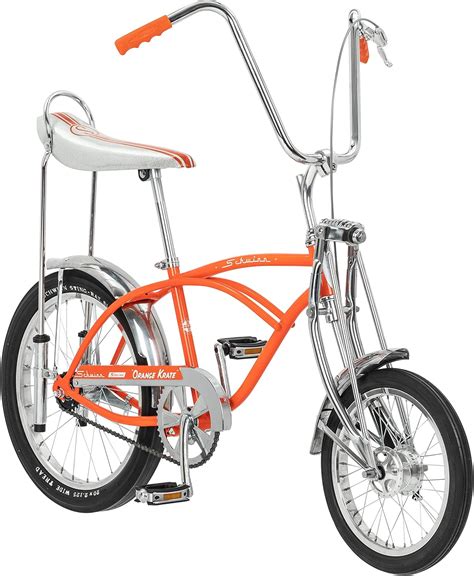
Los Inicios de Schwinn
The company was founded by Ignaz Schwinn (1860-1948) in Chicago in 1895, and in the 20th century became the dominant manufacturer of American bicycles. Schwinn first declared bankruptcy in 1992 and was restructured. Ignaz Schwinn was born in Hardheim, Baden, Germany, in 1860 and worked on two-wheeled ancestors of the modern bicycle that appeared in 19th century Europe. Schwinn emigrated to the United States in 1891. In 1895, with the financial backing of fellow German American Adolph Frederick William Arnold (a meat packer), he founded Arnold, Schwinn & Company.
Schwinn's new company coincided with a sudden bicycle craze in America. Chicago became the center of the American bicycle industry, with thirty factories turning out thousands of bikes every day. The boom in bicycle sales was short-lived, saturating the market years before motor vehicles were common on American streets. By 1905, bicycle annual sales had fallen to only 25% of that reached in 1900. Many smaller companies were absorbed by larger firms or went bankrupt; in Chicago, only twelve bicycle makers remained in business.
Realizing he needed to grow the company, Ignaz Schwinn purchased several smaller bicycle firms, building a modern factory on Chicago's west side to mass-produce bicycles at lower cost. He finalized a purchase of motorcycle manufacturer Excelsior Company in 1912, and in 1917 added the Henderson Company to form Excelsior-Henderson. At the close of the 1920s, the stock market crash decimated the American motorcycle industry, taking Excelsior-Henderson with it. Arnold, Schwinn, & Co. (as it remained until 1967) was on the verge of bankruptcy. With no buyers, Excelsior-Henderson motorcycles were discontinued in 1931.
Innovación y Resurgimiento
Ignaz's son, Frank W. "F. W." Schwinn, took over day-to-day operations at Schwinn. Putting all company efforts towards bicycles, he succeeded in developing a low-cost model that brought Schwinn recognition as an innovative company, as well as a product that would continue to sell during the inevitable downturns in business cycles. After traveling to Europe to get ideas, F. W. Schwinn returned to Chicago and in 1933 introduced the Schwinn B-10E Motorbike, actually a youth's bicycle designed to imitate a motorcycle.
The company revised the model the next year and renamed it the Aerocycle. For the Aerocycle, F. W. Schwinn persuaded American Rubber Co. Schwinn was soon sponsoring a bicycle racing team headed by Emil Wastyn, who designed the team bikes, and the company competed in six-day racing across the United States with riders such as Jerry Rodman and Russell Allen.
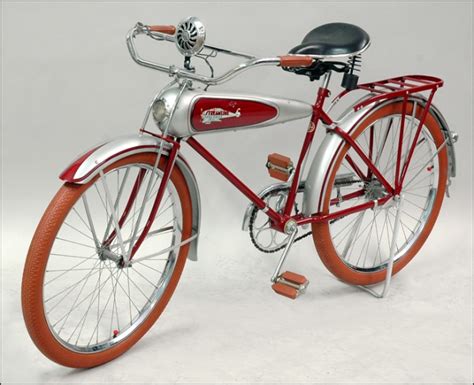
La Serie Paramount
In 1938, Frank W. Schwinn officially introduced the Paramount series. Developed from experiences gained in racing, Schwinn established Paramount as their answer to high-end, professional competition bicycles. The Paramount used high-strength chrome-molybdenum steel alloy tubing and expensive brass lug-brazed construction.
Estrategias de Marketing y Expansión
By 1950, Schwinn had decided the time was right to grow the brand. At the time, most bicycle manufacturers in the United States sold in bulk to department stores, which in turn sold them as store brand models. Schwinn decided to try something different. With the exception of B. F. Goodrich bicycles, sold in tire stores, Schwinn eliminated the practice of producing private label bicycles in 1950, insisting that the Schwinn brand and guarantee appear on all products.
In exchange for ensuring the presence of the Schwinn name, distributors retained the right to distribute Schwinn bikes to any hardware store, toy store, or bicycle shop that ordered them. In 1952, F. W. In the 1950s, Schwinn began to aggressively cultivate bicycle retailers, persuading them to sell Schwinns as their predominant, if not exclusive brand.
Competencia y Adaptación
During this period, bicycle sales enjoyed relatively slow growth, with the bulk of sales going to youth models. In 1900, during the height of the first bicycle boom, annual United States sales by all bicycle manufacturers had briefly topped one million. In 1946, imports of foreign-made bicycles had increased tenfold over the previous year, to 46,840 bicycles; of that total, 95 per cent were from Great Britain.
The postwar appearance of imported "English racers" (actually three-speed "sport" roadsters from Great Britain and West Germany) found a ready market among United States buyers seeking bicycles for exercise and recreation in the suburbs. Though substantially heavier than later European-style "racer" or sport/touring bikes, Americans found them a revelation, as they were still much lighter than existing models produced by Schwinn and other American bicycle manufacturers. Imports of foreign-made "English racers", sports roadsters, and recreational bicycles steadily increased through the early 1950s.
Schwinn first responded to the new challenge by producing its own middleweight version of the "English racer". The company also joined with other United States bicycle manufacturers in a campaign to raise import tariffs across the board on all imported bicycles. In August 1955, the Eisenhower administration implemented a 22.5% tariff rate for three out of four categories of bicycles. However, the most popular adult category, lightweight or "racer" bicycles, were only raised to 11.25%.
The administration noted that the United States industry offered no direct competition in this category, and that lightweight bikes competed only indirectly with balloon-tire or cruiser bicycles. The share of the United States market taken by foreign-made bicycles dropped to 28.5% of the market, and remained under 30% through 1964. Despite the increased tariff, the only structural change in foreign imports during this period was a temporary decline in bicycles imported from Great Britain in favor of lower-priced models from the Netherlands and Germany.
Declive en la Innovación y Problemas Legales
While every large bicycle manufacturer sponsored or participated in bicycle racing competition of some sort to keep up with the newest trends in technology, Schwinn had restricted its racing activities to events inside the United States, where Schwinn bicycles predominated. As a result, Schwinns became increasingly dated in both styling and technology.
By 1957, the Paramount series, once a premier racing bicycle, had atrophied from a lack of attention and modernization. Aside from some new frame lug designs, the designs, methods and tooling were the same as had been used in the 1930s. After a crash-course in new frame-building techniques and derailleur technology, Schwinn introduced an updated Paramount with Reynolds 531 double-butted tubing, Nervex lugsets and bottom bracket shells, as well as Campagnolo derailleur dropouts. The Paramount continued as a limited production model, built in small numbers in a small apportioned area of the old Chicago assembly factory.
The new frame and component technology incorporated in the Paramount largely failed to reach Schwinn's mass-market bicycle lines. In 1963 following the death of F. W. By the late 1950s, Schwinn's exclusive marketing practices were well entrenched in the United States, practices that had ensured a dominant position in the United States bicycle market.
In order to prevent competition among its wholesalers, Schwinn assisted them by dividing up the national market. Schwinn also strengthened its dealer network, shrinking the number of authorized dealers. Since Schwinn could decide who got their bikes and who didn't, the company rewarded the highest volume dealers with location exclusivity, as well as mandating service standards and layouts.
In response, the company was sued by the Department of Justice in 1957 for restraint of trade. In a ten-year legal battle, many of Schwinn's practices were upheld by the courts: judges ruled they had the right to have their bicycles sold by retailers equipped to service the bikes as well as sell them. v. Arnold, Schwinn & Co., Schwinn was found guilty of restraint of trade by preventing distributors shipping bicycles to unapproved dealers. Though the Arnold decision would be essentially overturned in later rulings, the company stopped working solely through independent local distributors and constructed four regional warehouses from which bicycles would - legally - be sent to shops.
Marketing Infantil y Objeciones
During the 1960s, Schwinn aggressively campaigned to retain and expand its dominance of the child and youth bicycle markets. The company advertised heavily on television, and was an early sponsor (from 1958) of the children's television program Captain Kangaroo. The Captain himself was enlisted to regularly hawk Schwinn-brand bicycles to the show's audience, typically six years old and under.
As these children matured, it was believed they would ask for Schwinn bicycles from their parents. By 1971, United States government councils had objected to Schwinn's marketing practices. In response, Schwinn had Captain Kangaroo alter its format. The Captain no longer insisted that viewers buy a Schwinn, but instead made regular on-air consultations of a new character, "Mr.
Modelos Emblemáticos de Schwinn
Corvette
Schwinn developed the Corvette in 1954, after their catalog, for that year, had been in use. Therefore, with the release of a single photograph, the Corvette was introduced. The picture showed company executives standing behind their new product, that would remain in production for 10 years.
Tandems
From Schwinn's earliest years in the 1890s to the 1980s, Schwinn produced a series of tandem bicycles. From 1946 to 1963, the tandem frames were hand brazed with seamless chromoly tubing and featured a short wheelbase with a curved rear seat tube, heavy duty tandem components, and an eccentric front bottom bracket for chain adjustment.
In 1959, the tandems were given the model name Town & Country. In 1963, the electro-welded Schwinn Twinn tandem was introduced at a retail price of $99.95, with the Town & Country at $175. The Town & Country disappeared from the catalog in 1964. The Twinn was eventually offered in three different models: the single speed Twinn, a two speed semi-automatic, and the five speed Deluxe Twinn. The Twinn used a straight rear seat tube and an idler sprocket to adjust the timing chain tension, typically found on low-priced tandems.
In 1969, the Paramount tandem was introduced, returning to fillet-brazed, seamless chromoly tubing and an eccentric front bottom bracket chain adjustment system. It kept some of the heavy duty features of the discontinued Town & Country model but lengthened the wheelbase and fitted with lightweight components including TA (later Campagnolo) aluminum cranksets, aluminum 27" rims on Campagnolo hubs with heavy, 12-gauge spokes, Brooks leather saddles, Cinelli handlebars and stem, and Campagnolo pedals. 1969 retail price was $397 for both the double-diamond and rear step-through frame designs, each in two different frame sizes in the customer's choice of color.
The Paramount tandems were sold alongside the Twinn until 1979, when the retail price of the Paramount had risen to $1,395. In 1975, Schwinn re-introduced the curved rear seat tube on the Paramount models, calling it a "short coupled" design. The Twinn series continued through 1982. From 1989 through 1992, Schwinn offered a tandem called the Duo Sport, which used a lugged frame built with oversized tubing in Japan and equipped with quality, mid-range components.
Sting-Ray
In 1962, Schwinn's designer Al Fritz heard about a new youth trend centered in California for retrofitting bicycles with the accoutrements of motorcycles customized in the "bobber" or "chopper" style, including high-rise, "ape-hanger" handlebars, and low-rider "banana seats". Inspired, he designed a mass-production bike for the youth market known as Project J-38. The Sting-Ray had ape-hanger handlebars, Persons's Solo Polo Seat banana seat, and 20-inch (510 mm) tires.
Sales were initially slow, as many parents desiring a bicycle for their children did not relate to the new, unconventional design. In the December 1963 Schwinn Reporter, Schwinn announced the arrival of the Deluxe Sting-Ray. In July 1964, Schwinn announced the arrival of the Super Deluxe Sting-Ray. This model included a front spring-fork, a new sleeker Sting-Ray banana seat, and a Person's Hi-loop Sissy bar.
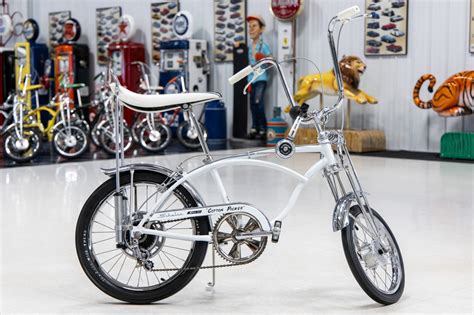
Varsity, Continental y LeTour
A growing number of US teens and young adults were purchasing imported European sport racing or sport touring bicycles, many fitted with multiple derailleur-shifted gears. Schwinn decided to meet the challenge by developing two lines of sport or road 'racer' bicycles. One was already in the catalog - the limited production Paramount series.
As always, the Paramount spared no expense; the bicycles were given high-quality lightweight lugged steel frames using double-butted tubes of Reynolds 531 and fitted with quality European components including Campagnolo derailleurs, hubs, and gears. The Paramount series had limited production numbers, making vintage examples quite rare today.
Starting in 1960, for the rest of the market, Schwinn offered the Schwinn Varsity, Continental, and LeTour -- now equipped as multi-geared sport bikes (10-speeds), and designed to imitate the style of the new narrow-tired 'racing' and sport bikes from Europe, though not their performance. The 1960 Varsity was introduced as an 8-speed bike, but in mid-1961 was upgraded to 10 speeds. Other road bikes were introduced by Schwinn in the early and mid 1960s, such as the Superior, Sierra, and Super Continental, but these were only produced for a few years.
The Varsity and Continental sold in large numbers through the 1960s and early 1970s, becoming Scwhinn's leading models. The major difference between the two models was the use of a tubular front fork on the Continental -- both bikes used the same frame design, a lugless, steel unit, using Schwinn's standard Ashtabula cranksets and welded in such a way that the joints were smoothly filled (similar to the joints in 21st-century composite frames).
In the late 1960s, the Varsity and Continental pioneered the use of auxiliary brake levers, which allowed the rider to rest hands on the straight, horizontal center section of the ram's horn handlebars, yet still have braking control. To further improve control from this more-erect riding position, the levers used to move the derailleurs (shifting the chain from one sprocket to the next) were moved from the traditional position on the "down tube" to the top of the headset, on a ring which would turn with the handlebar stem. This feature, attractive to older riders, soon found its way to other Schwinn models, especially those intended for senior citizens.
By the mid-1970s, competition from lightweight and feature-rich imported bikes was making strong inroads in the budget-priced and beginners' market. While Schwinn's popular lines were far more d...